During the month of February, I will be featuring spotlights on several tales that celebrate Black History Month. The origins of Black History Month began during the early 20th century. During 1915, motivated by his strong desire to put a spotlight on the accomplishments of African-Americans, a historian named Carter G. Woodson founded the Association for the Study of Negro Life and History (presently called the Association for the Study of African American Life and History or ASALH for short). The ASALH quickly established the publication of The Journal of Negro History, and a decade later, Carter Woodson's plan for a week of celebration and activities devoted to African-American history became a reality. On February 7, 1926, the first Negro History Week was held. Fifty years later, the ASALH expanded the week-long celebration of African American history to a month, and Black History Month began.
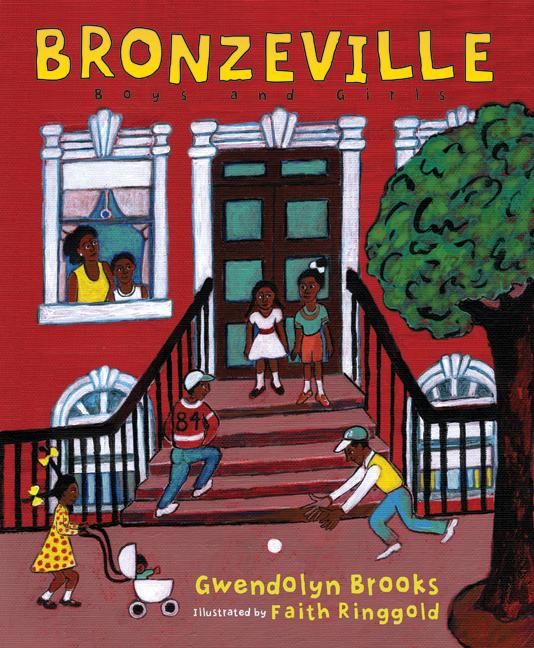
My first spotlight during this historic month long celebration is Bronzeville Boys and Girls. This classic, multicultural collection of 34 poems by the late poet laureate and Pulitzer-Prize winner Gwendolyn Brooks takes it's readers on a trip back in time to the Bronzeville section of Chicago during the 1950s. Each of these simple poems are narrated from a particular characters point of view- where we learn that every child who lives in Bronzeville has a story to tell- some are happy tales from characters including "Narcissa", who reminded me of much younger self...
"...Small Narcissa sits upon
A brick in her back yard
And looks at tiger lilies,
And shakes her pigtails hard.
First she is an ancient queen
in pomp and purple veil.
Soon she is a singing wind.
And next, a nightingale."
Like Narcissa, I too, was content to sit by myself at hours at a time underneath the tall oak trees in my backyard, or at playtime while in grade school, you could also find me sitting up on a hill underneath the windows of my classroom content in daydreaming. My mind would wonder and take my imagination to far off places and adventures just as they do for Narcissa.
To the innocence on display in "Cynthia in the Snow" which also brought back such sweet memories as it took me back to my childhood grade school, Larkfield Elementary School on Long Island, New York. The illustrations by the acclaimed award-winning artist Faith Ringgold, to this short passage of the sounds, feel and appearance of snow are astonishingly similar to how my old school looked like, complete with the long cement walkway to the front doors, to the huge oak tree standing majestically in the front of the school, and brought back memories of myself and my classmates looking forward to being able to play in the snow at recess time.
And ultimately, some stories that emphasize the real life struggles that many children, regardless of race, face on a daily basis in our country, that will break your heart heart, as does the entry "John, Who is Poor"
"Oh little children, be good to John!-
Who lives so lone and alone.
Whose Mama must hurry to toil all day.
Whose Papa is dead and done..."
With every poem, it was quite obvious to me how Brooks weaved her masterful lyrical talents throughout this vast collection that showed the beauty, imagination, happiness and yes, heartbreak, of a neighborhood and it's neighbors through the innocent eyes of a child.
Bronzeville Boys and Girls
Written by Gwendolyn Brooks & Illustrated by Faith Ringgold
Originally published in 1956, now Published by Amistad, an imprint of HarperCollins Publishers.
For Ages 4 thru 8
Website: www.harpercollinschildrens.com
Retails for 6.99 (paperback)

No comments:
Post a Comment